

01
Voice of Customer Analysis
BuildBetter extracts and clusters the exact language customers use to describe their problems. Surface the phrases that appear most often — the words your homepage should be using right now.

A customer-led workflow
Stop guessing at messaging. Build your entire positioning strategy from actual customer language extracted from sales and customer calls — and watch conversion rates follow.
Customer evidence

“Citations in reports are critical for us. They build trust and prove accuracy — when leadership sees top citations, it reinforces credibility.”
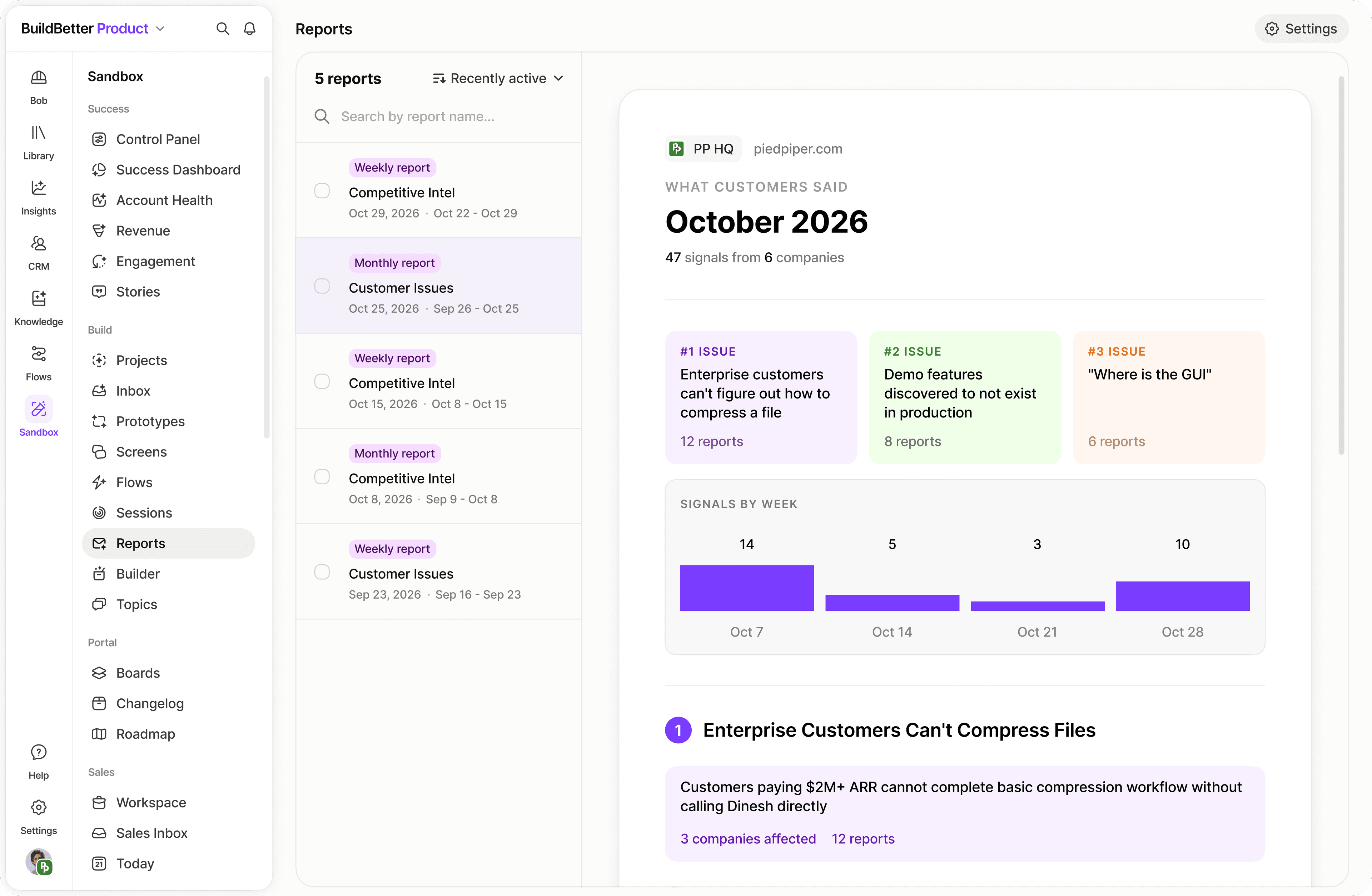
Ask a specific question of your company context. Inspect the accounts and source material behind the answer before using it in a report or a team decision.
01
BuildBetter extracts and clusters the exact language customers use to describe their problems. Surface the phrases that appear most often — the words your homepage should be using right now.
02
Quantify which problems matter most to which customer segments. See how often each pain point is mentioned, with what emotional intensity, and by which buyer profiles — so you can lead with what actually drives decisions.
03
Ask Chat to identify what your most successful customers have in common. Instead of a broad persona ('growing companies'), you get a precise ICP ('Operations managers at 10–100 person B2B companies scaling past their spreadsheets').
04
Build value props from outcomes customers already describe in their own calls. Every line of copy maps back to a real customer quote — so you can tell sales exactly where your messaging came from.
05
Surface what prospects say about alternatives they considered, why they chose you, and what objections they had. Build positioning and battle cards grounded in actual buyer language, not analyst frameworks.
06
Run a weekly query on new sales calls to catch shifting language, emerging objections, and new ICP characteristics. Messaging stays current as your market evolves.
Work with your sales leader to access recent discovery calls and demos — a mix of won and lost deals from different customer segments. If sales uses Gong or Chorus, export and upload to BuildBetter.
Tag each recording: 'Sales - Won Deal', 'Sales - Lost Deal', 'Discovery Call', 'Demo Call'. Processing takes 10–30 minutes per hour-long recording.
Focus on what words customers use (not your words), what emotional tone comes through, what triggered their search, and what outcomes they actually want — not features.
After each call, check the Signals section. Filter for Problem, Need, Praise, and Objection types. BuildBetter already pulled the key quotes — you're looking for patterns across calls.
Go to Signals, filter by Type = Problem, and read through them all. Look for the same problem mentioned by three or more customers — those are your headline pain points.
Query: 'How do customers describe their pain points? Give me their exact language, not summarised.' The output shows common phrases, emotional words, and how they frame the problem — not how you describe it.
Query: 'Who are our most successful customers? What do they have in common?' Look for patterns in company size, industry, role, tech stack, and the trigger event that made them act.
Filter Signals by Type = Praise, Sentiment = Positive, then export to CSV. This is your raw material for testimonials, website copy, and sales decks.
Replace vague taglines with the pain point language your customers actually use. 'Streamline your workflow' becomes 'Stop drowning in spreadsheets. One place for all your data.'
Swap feature bullets for outcome statements from real calls. 'Real-time sync' becomes 'One source of truth your whole team can trust.' Every line should echo something a real customer said.
Update your persona language from 'growing companies' to the precise description your data surfaced. Specific resonates; broad is ignored.
Send a summary to sales: top pain points, ICP characteristics, and outcome language. Then A/B test old versus new homepage copy. Expect 20–40% conversion improvement within 30 days.
Query Chat: 'What new pain points or language emerged in this week's sales calls?' Stay ahead of shifting customer language before it affects conversion.
Deep-analyse 10–20 calls, update your quote library, and check whether ICP patterns have shifted. Adjust homepage and ad copy accordingly.
Full review: competitive positioning, segment-specific messaging variations, and value prop hierarchy. Share insights company-wide.
Bring a real question. We’ll walk through the context and the next step together.
Book a demo