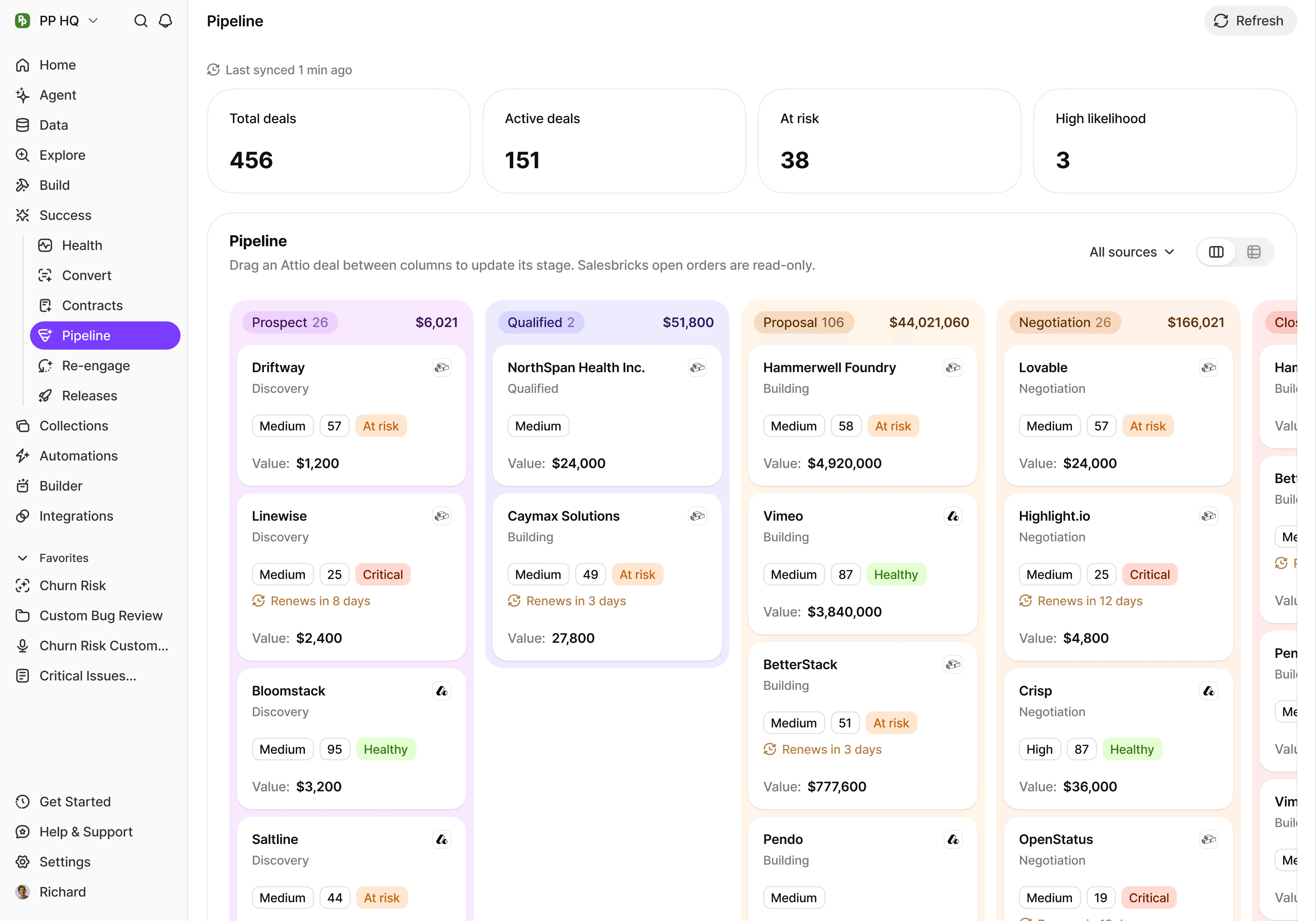
Pipeline Intelligence
Transform your sales pipeline with AI-powered insights that predict deal outcomes, surface hidden risks, and provide recommendations that help you close more deals faster — replacing gut-feel forecasting with data you can trust.
Sales leaders manage millions in pipeline value with spreadsheets and instinct. BuildBetter changes that by analyzing every customer interaction, scoring each deal's health in real time, and surfacing the risks and opportunities that would otherwise stay invisible until it's too late to act. Move from reactive firefighting to proactive pipeline acceleration.
Why pipeline management breaks down
- 57% of deals slip from committed quarters due to risks that weren't visible in time
- Sales leaders spend 8+ hours per week on forecast calls that could be automated
- CRM data is 42% inaccurate because manual updates are inconsistent and often skipped
- Critical deal risks go unnoticed until they become terminal — ghosted champions, competitor threats, budget freezes
- Win rates stagnate without insight into what behaviors and activities actually predict a close
- Deals get single-threaded, with no visibility into which stakeholders are disengaged and where coverage is weak
Capabilities
Predictive Deal Scoring
AI scores every deal across four dimensions — engagement, momentum, fit, and risk — updated in real time after every interaction. See at a glance which deals are on track and which need immediate attention, with specific recommended actions for each.
Proactive Risk Detection
Get contextual alerts when deal health drops, champions go dark, close dates push, or competitors are mentioned multiple times. Risk detection happens continuously, not just when someone updates the CRM.
Pipeline Velocity Analytics
Identify which stages are creating bottlenecks, how long deals spend in each phase, and what activities consistently accelerate deals through the funnel. Stop guessing at root causes and see the data.
Stakeholder Coverage Intelligence
Map every engaged stakeholder per deal, score their relationship strength, and surface gaps — missing economic buyers, unengaged executive sponsors, single-threaded dependencies — before they become deal killers.
AI-Powered Forecast Automation
Replace painful weekly forecast calls with AI-generated predictions that show confidence levels by deal, highlight where rep commits diverge from AI predictions, and surface which deals need conversation before the quarter ends.
Next Best Action Engine
For every deal in the pipeline, get specific AI recommendations — which stakeholder to engage, what content to share, which activity historically accelerates similar deals — grounded in your own won deal history.
How to get started
A structured approach to rolling out this workflow in your team.
Phase 1 — Foundation (Week 1)
Connect your data sources
Integrate your CRM (Salesforce or HubSpot), connect email and calendar for communication tracking, and enable call recording. Import 6 months of historical deal data so AI predictions are accurate from day one.
Configure deal intelligence signals
Define your winning deal characteristics and set up risk signals — no activity in 14+ days, competitor mentioned 3+ times, decision maker not engaged, budget concerns raised, or timeline pushing repeatedly.
Build smart pipeline views and alerts
Create filtered views for deals needing attention (score below 60), fast movers, at-risk deals closing this quarter, and ready-to-close opportunities. Set up Slack and email notifications for priority risk alerts.
Phase 2 — Advanced Analytics (Weeks 2–4)
Build multi-factor deal scoring
Refine your scoring model across engagement (30%), momentum (25%), fit (25%), and risk (20%) dimensions. Calibrate weights based on which factors best predict your historical win patterns.
Run pipeline velocity analysis
Analyze average time in each stage, identify the biggest bottlenecks, and map which activities — executive briefings, ROI workshops, reference calls, site visits — consistently reduce cycle length.
Establish multi-threading benchmarks
Set coverage standards per deal stage and use stakeholder maps to identify which deals are dangerously single-threaded. Deals with 3+ engaged contacts close 67% more often.
Phase 3 — Intelligent Automation (Month 2+)
Activate smart deal alerts at scale
Set up high-priority alert rules for critical risk events — score drops over 15% in 48 hours, no contact in 10+ days in late stages, champion gone dark, new unknown stakeholder appears — with context-rich notifications and recommended actions.
Replace forecast calls with AI-driven reviews
Pre-populate deal reviews with AI confidence scores, risk mitigation plans, and upside opportunities. When AI and rep forecasts differ by more than 20%, the AI is right 78% of the time — use that data.
Build ICP-focused pipeline hygiene
Analyze won deals from the last 6 months to build an ICP scorecard, score your current pipeline against it, and reallocate resources toward high-fit deals while deprioritizing poor-fit opportunities early.
Before & After
Real-world impact teams see after adopting this workflow.
Best Practices
Recommended Practices
- Trust the AI signal: when AI and rep forecasts differ by more than 20%, the AI is right 78% of the time.
- Act on risk alerts within 48 hours — deals saved in that window have a 3x higher recovery rate than those addressed later.
- Multi-thread everything: deals with 3 or more engaged contacts close 67% more often than single-threaded deals.
- Keep CRM data current in real time — fresh data improves AI prediction accuracy by 40% compared to weekly batch updates.
- Review the full pipeline weekly — teams that hold structured weekly pipeline reviews close 25% more deals than those that don't.
- Use deal recovery success rate data to prioritize which at-risk deals to invest in — recovery rates vary significantly by deal type and risk signal.
Watch Out For
- Ignoring early warnings lets small risks compound — the sooner you address a declining deal score, the higher your recovery rate.
- Reps who constantly override AI recommendations underperform by 31% — build trust in the system by validating it against historical outcomes.
- Missing activities in CRM reduce prediction accuracy by up to 45% — incomplete data creates blind spots that defeat the purpose of AI scoring.
- Forecast theater is dangerous: don't optimize for making your forecast look good — optimize for improving actual close rates.
Pro Tips
- Any deal with no activity for 48 hours in late stages is at risk. Set automated alerts and keep a re-engagement template ready to send immediately.
- Share AI health scores transparently with prospects — framing like 'our system shows we're aligned on timeline and success criteria' builds trust and creates momentum.
- Run a reverse engineering exercise: have AI analyze your last 12 months of lost deals to identify early warning patterns. Most losses are predictable 3+ weeks before they happen.
- Weekly pipeline therapy sessions — where reps discuss stuck deals with peers — often surface creative solutions that AI recommendations alone might miss.
Ready to replace gut-feel forecasting with a pipeline you can trust?
Join thousands of teams already using BuildBetter to turn customer conversations into actionable insights.