

01
Strategy Formulation
Build strategies grounded in real customer and market intelligence rather than gut instinct. AI-powered SWOT analysis, scenario modeling, and strategic option generation ensure every plan reflects ground truth.

A customer-led workflow
Bridge the strategy-execution gap with AI that tracks progress in real-time, predicts roadblocks, and ensures your vision becomes reality with 3x higher success rates.
Customer evidence

“Citations in reports are critical for us. They build trust and prove accuracy — when leadership sees top citations, it reinforces credibility.”
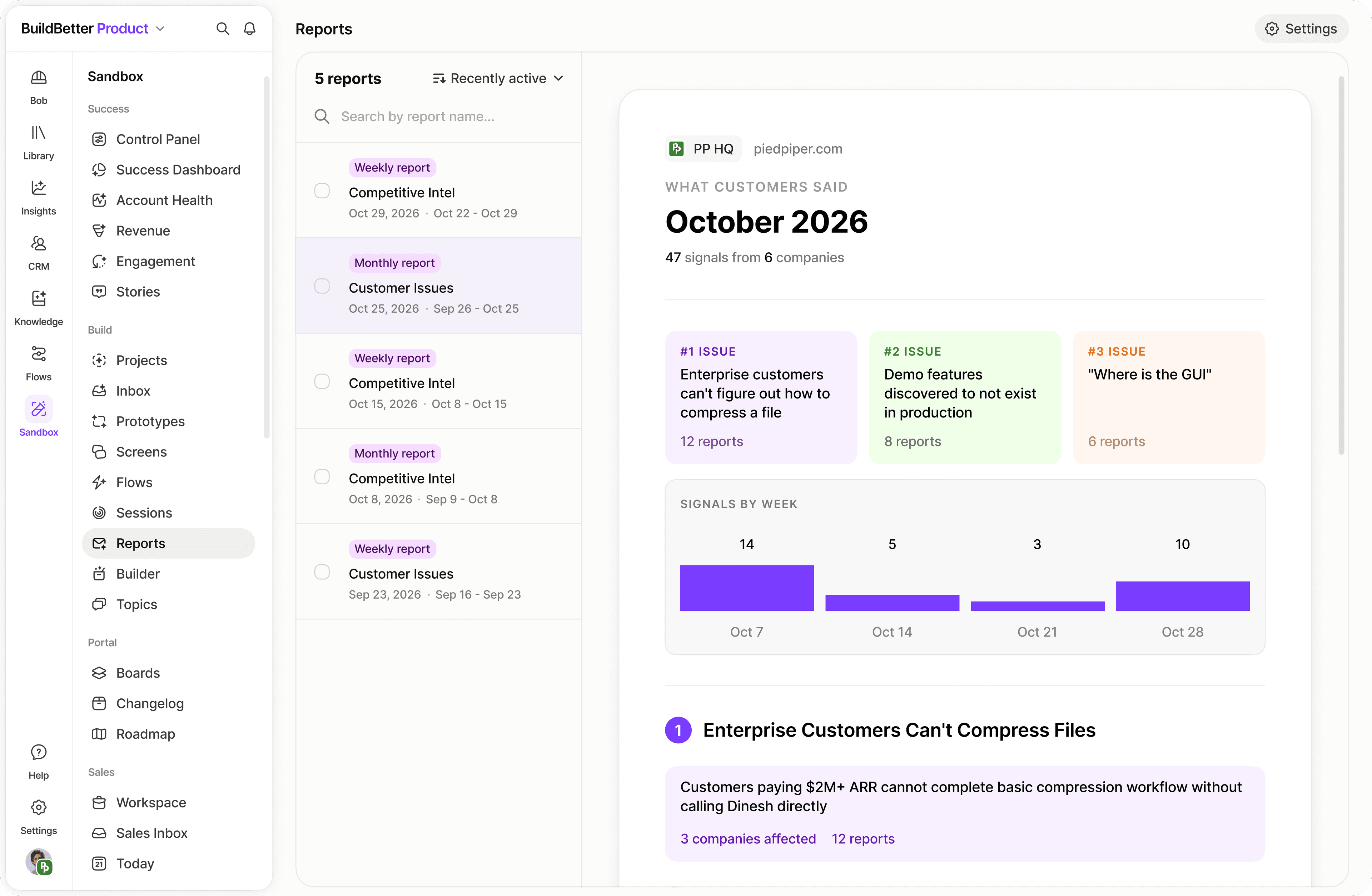
Ask a specific question of your company context. Inspect the accounts and source material behind the answer before using it in a report or a team decision.
01
Build strategies grounded in real customer and market intelligence rather than gut instinct. AI-powered SWOT analysis, scenario modeling, and strategic option generation ensure every plan reflects ground truth.
02
Monitor every strategic initiative in real time with AI that predicts failure before it happens. Track timelines, budgets, resource constraints, and market windows simultaneously.
03
Ensure every team member and function drives toward the same strategic goals. Surface misalignment early — before small disconnects compound into major execution failures.
04
Replace annual planning cycles with continuous strategy evolution. Adjust based on live market feedback, competitive moves, and execution reality without waiting for the next offsite.
Integrate market intelligence, customer insights, competitive win/loss data, and team performance signals to build a data-driven foundation for planning.
Analyze the past three years of strategic plans — successes, failures, market timing, resource allocation, and execution bottlenecks — to extract learning patterns.
Configure AI to continuously surface opportunity signals, threat indicators, and execution friction points from every conversation and data source.
Create a cascading OKR framework that links company objectives down to team-level key results, with automated progress tracking and deviation alerts.
Activate Monday intelligence briefs that analyze market signals, track strategic KPIs, identify execution blockers, and distribute action items to leadership.
Generate and stress-test strategic options against multiple market scenarios. Data-driven strategies succeed 3.4x more often than intuition-based plans.
Track initiative health across timeline, budget, resources, and market window simultaneously. Receive predictive alerts with recommended interventions before issues escalate.
Score alignment by function and surface misalignment before it derails execution — Engineering priorities, Marketing messaging, and Sales enablement all visible in one view.
Run a live risk intelligence dashboard covering critical, moderate, and low risks with early warning signals, probability scores, and pre-built mitigation playbooks.
Replace annual planning with a rolling cycle: daily market monitoring, weekly pulse checks, monthly deep dives, and quarterly major pivots only when warranted.
Dynamically reallocate resources across core business, growth initiatives, and innovation bets as market signals shift — with reversible, phased changes.
Orchestrate initiatives end-to-end: pre-launch readiness tracking, daily war rooms, bottleneck elimination, and cross-initiative synergy capture.
Raise organizational strategy IQ from 23% awareness to 90% through OKR transparency, initiative showcases, decision velocity improvements, and innovation pipelines.
Bring a real question. We’ll walk through the context and the next step together.
Book a demo